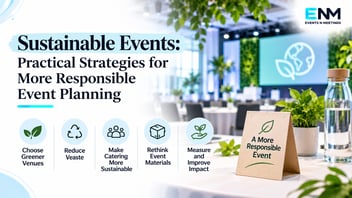
Sustainable Event Planning: A Step-by-Step Guide for Event Teams
Event sustainability is no longer something that sits at the end of an event checklist. It is increasingly becoming part of how modern event teams make decisions — from choosing a venue and suppliers to managing food, transport, energy, technology and attendee experience.
But sustainable event planning does not mean making an event completely paperless, removing every plastic item or choosing the most expensive “green” supplier. It is about understanding the environmental, social and economic impacts of an event and making deliberate decisions to reduce negative impacts while creating lasting value.
The international standard ISO 20121:2024 provides a framework for event sustainability management systems and applies to events of different types and sizes. It takes a holistic approach covering environmental, social and economic impacts, while also placing greater emphasis on areas such as inclusivity and event legacy.
For event teams, the biggest opportunity is to move from isolated sustainability initiatives to a structured event sustainability strategy.
This step-by-step guide explains how to do exactly that.
Start With a Sustainability Brief
The first step in sustainable event planning should happen before the venue is booked, the caterer is selected or the first invitation is sent.
Create a sustainability brief alongside the main event brief.
The document should establish:
- The event's sustainability objectives
- Key environmental priorities
- Social and accessibility priorities
- Procurement expectations
- Waste-reduction targets
- Travel considerations
- Measurement requirements
- Roles and responsibilities
For example, an event team could set objectives such as:
“Reduce printed materials by 50%.”
“Prioritise public-transport access when selecting the venue.”
“Increase the proportion of reusable event materials.”
“Measure food waste after the event.”
Specific objectives are more useful than simply stating that the event should be “green”.
ISO 20121:2024 is designed around integrating sustainability into event planning and execution rather than treating it as a separate activity.
The event team's first question should be:
What do we want sustainability to achieve at this event?
Once that is clear, subsequent decisions become much easier.
Map the Event's Biggest Impacts
Not every event has the same sustainability challenges.
A two-day international conference may have significant attendee-travel and accommodation impacts. A local exhibition may have greater challenges around temporary structures, printed materials and exhibition waste. A festival may have substantial energy, transport, water and crowd-management requirements.
Before deciding what to change, map the event lifecycle.
Consider five stages:
Before the event
Planning, procurement, invitations, production and transportation.
Arrival
Attendee travel, accommodation, registration and accessibility.
During the event
Energy, catering, water, materials, waste and attendee experience.
Breakdown
Dismantling, transportation, disposal and storage.
After the event
Reporting, supplier review, feedback and legacy activities.
This prevents event teams from focusing only on what attendees can see.
Choose the Venue Strategically
Venue selection is one of the most influential decisions in sustainable event planning.
A venue can affect transportation, energy consumption, waste management, catering, accessibility and supplier logistics.
Instead of asking only:
“Does this venue look good?”
ask:
“Can this venue help us achieve our sustainability objectives?”
Add sustainability questions to your venue checklist:
- Is the venue accessible by public transport?
- Does it provide accessible entrances and facilities?
- What waste-management systems are available?
- How is energy consumption managed?
- Can heating and cooling be adjusted according to occupancy?
- Does the venue have sustainability policies?
- Can existing furniture and infrastructure be reused?
- Can catering operate with reusable serviceware?
- Can suppliers access the venue efficiently?
- Does the venue provide sustainability data?
A beautiful venue that requires extensive additional production, transport and disposable infrastructure may not be the most sustainable choice.
Think beyond the building. Think about everything the building makes possible.
Design a Lower-Impact Attendee Journey
Sustainability should be built into the attendee journey rather than added as a message at registration.
Think about what happens from the moment someone receives an invitation until they leave the event.
Before arrival
Provide:
- Public transport information
- Walking routes
- Cycling information where relevant
- Accommodation information
- Digital registration
- Clear accessibility information
During arrival
Consider:
- Digital check-in
- QR-based registration
- Reusable badges
- Clear signage
- Efficient registration layouts
During the event
Make sustainable choices visible but convenient.
For example, rather than simply telling attendees to recycle, place clearly marked waste stations where people naturally need them.
Good sustainable event planning removes friction.
If the sustainable option is difficult, inconvenient or unclear, attendees are less likely to use it.
Rethink Event Materials
Event teams often underestimate how much temporary material an event creates.
Think about:
- Banners
- Directional signage
- Printed programmes
- Name badges
- Exhibition graphics
- Menus
- Flyers
- Stage branding
- Promotional merchandise
- Packaging
The first question should not be:
“Can this be recycled?”
It should be:
“Do we need to produce this in the first place?”
Use the four-step material hierarchy:
Reduce → Reuse → Repurpose → Recycle
For example, instead of producing a large branded backdrop for one event, create modular signage that can be adapted for multiple events.
Instead of printing a programme that may become outdated during the day, provide a digital agenda that can be updated instantly.
This can also improve operational efficiency.
Make Catering Part of the Sustainability Strategy
Food is an important part of the attendee experience — and an important part of sustainable event planning.
A responsible catering strategy should consider not only what is served but also how much is ordered, where ingredients come from and what happens to leftovers.
Work with caterers on:
- Accurate attendee estimates
- Seasonal ingredients where practical
- Local sourcing where appropriate
- Plant-forward choices
- Reusable serving equipment
- Reduced packaging
- Water provision
- Food-waste measurement
- Appropriate handling of surplus food
One of the simplest improvements is better forecasting.
Over-ordering creates unnecessary waste and costs money.
At the same time, sustainability should not mean reducing choice to the point that attendees with dietary, cultural or medical requirements are excluded.
Responsible catering should combine sustainability with inclusion.
Build Sustainable Procurement Into Supplier Selection
Your event's sustainability performance is only partly controlled by the event team.
Suppliers have a major influence.
A production company determines how materials are transported and installed. A caterer influences food and packaging. A venue influences energy and waste. An exhibition contractor influences stand materials.
This means supplier selection should consider more than price.
Add questions such as:
- What sustainability policies do you have?
- Can materials be reused?
- How do you manage waste?
- Can you reduce packaging?
- How are goods transported?
- Can you provide relevant sustainability data?
- What accessibility practices do you follow?
- Can you demonstrate previous sustainable event work?
Rather than creating unrealistic requirements for every supplier, identify the areas where each supplier has the greatest influence.
This makes sustainable event planning more practical and measurable.
Reduce Energy Consumption Without Reducing the Experience
An event does not need to feel less impressive to use resources more thoughtfully.
Lighting, screens, sound systems, heating, cooling, charging stations and exhibition equipment can all contribute to energy use.
Event teams can work with venues and production partners to:
- Use energy-efficient lighting
- Switch equipment off when not required
- Avoid excessive lighting
- Match room capacity to expected attendance
- Use existing venue infrastructure where possible
- Coordinate equipment schedules
- Ask production suppliers about energy-efficient equipment
The aim is not to eliminate technology.
Instead, use technology with intention.
A screen that supports the event experience is valuable. Ten screens displaying the same information because they were included in a package may not be.
Make Travel Part of Event Design
For many events, getting people to the venue can have a much larger impact than the paper used inside it.
Travel should therefore be considered during venue selection and attendee communication.
Practical strategies include:
- Select venues close to public transport.
- Share train and public transport information.
- Encourage walking where practical.
- Provide secure cycle facilities where available.
- Coordinate accommodation near the venue.
- Use shuttle transport strategically.
- Consider whether some participants can join remotely.
- Group activities to minimise unnecessary travel.
For international conferences, travel decisions may be particularly significant.
However, virtual participation should not automatically replace in-person interaction. The better question is whether each journey is necessary for the event's purpose and whether lower-impact alternatives can achieve the same objective.
Make Accessibility Part of Sustainable Event Planning
Sustainability is broader than carbon, waste and energy.
The social dimension of event sustainability matters too.
ISO 20121:2024 strengthens the focus on areas including inclusivity, human rights and event legacy.
An event should therefore consider whether people with different needs can participate comfortably and meaningfully.
Review:
- Step-free access
- Accessible toilets
- Seating arrangements
- Hearing assistance
- Captioning
- Signage
- Accessible digital content
- Dietary requirements
- Quiet spaces where appropriate
- Diverse speaker representation
- Safe working conditions
A sustainable event should not simply consume fewer resources.
It should create a better experience for the people who attend, work at and interact with it.
Give Attendees a Role — Without Lecturing Them
One of the most effective ways to make sustainability part of the event experience is to involve attendees.
But avoid turning the event into a series of instructions.
Instead of:
“Do not use plastic.”
try:
“Bring your reusable bottle — refill stations are available throughout the venue.”
Instead of:
“Use public transport.”
provide a simple journey guide showing the easiest routes.
You can also create small interactive elements:
- Sustainability pledge walls
- Reusable-badge return points
- Waste-sorting challenges
- Local food showcases
- Sustainability dashboards
- Community activities
The objective is to make responsible behaviour easy, visible and engaging.
Think Beyond the Event Day
One of the biggest mistakes in sustainable event planning is treating sustainability as something that ends when attendees leave.
Ask what happens to everything afterwards.
After the event:
- Where will signage go?
- Can furniture be reused?
- What happens to leftover food?
- Can exhibition materials be stored?
- Can unused merchandise be repurposed?
- What happens to waste?
- Which suppliers performed well?
- What did attendees think?
- What should change next time?
This is where the idea of event legacy becomes important.
ISO 20121:2024 emphasises event legacy as part of its broader sustainability approach.
A successful sustainable event should ideally leave something useful behind — whether that is knowledge, community benefit, reusable infrastructure, stronger local relationships or improved organisational practices.
Measure What You Actually Want to Improve
You cannot manage sustainability effectively if you never measure it.
But that does not mean creating a complicated 50-page sustainability report.
Start with a manageable set of indicators.
Possible sustainable event metrics:
|
Area |
What to measure |
|
Waste |
Total waste and proportion diverted from disposal |
|
Materials |
Percentage reused or repurposed |
|
Travel |
Attendee transport patterns |
|
Energy |
Energy consumption where data is available |
|
Food |
Food waste and catering quantities |
|
Procurement |
Local or sustainability-screened suppliers |
|
Accessibility |
Measures implemented |
|
Attendee experience |
Sustainability-related feedback |
|
Legacy |
Post-event outcomes |
The right metrics depend on the event.
ISO describes its event sustainability framework as applicable to different types and sizes of events and designed to help organisations manage their environmental, social and economic impacts.
Measure the areas where you can actually make decisions.
Create a Sustainable Event Dashboard
For larger event teams, turn sustainability into a simple dashboard.
Imagine the event manager opening the dashboard a week before the event and seeing:
Venue: Public transport accessible
Printing: 70% reduced
Catering: 85% confirmed against registrations
Reusable signage: 90%
Accessibility: Checked
Waste stations: Confirmed
Supplier sustainability requirements: 100% communicated
Post-event measurement: Assigned
This transforms sustainability from an abstract ambition into an operational system.
It also makes accountability clearer.
Assign every major sustainability objective an owner.
For example:
Catering → Catering Manager
Waste → Operations Lead
Travel → Attendee Experience Team
Supplier standards → Procurement
Measurement → Sustainability Lead
Communicate Sustainability Without Greenwashing
An event team can have good sustainability practices and still undermine its credibility through vague marketing claims.
Avoid statements such as:
- “100% green event”
- “Zero-impact event”
- “Completely sustainable”
- “Carbon-free event”
unless the claims can be properly substantiated.
Instead, communicate specific actions.
Weak:
“We are hosting an eco-friendly conference.”
Stronger:
“The conference will use digital programmes, reusable signage and a venue accessible by public transport, while post-event waste will be measured and reported.”
Specific communication is more credible.
It also allows attendees, sponsors and stakeholders to understand exactly what the organisation has done.
Build a Post-Event Sustainability Review
The final step is often forgotten.
Once the event is over, hold a short sustainability review.
Ask:
What worked?
Which measures were easy to implement and produced useful results?
What did not work?
Were there problems with suppliers, waste stations, attendee behaviour or data collection?
What surprised us?
Did actual attendance, food consumption or travel patterns differ from expectations?
What should become standard?
Identify practices that should be built into future events.
What should change?
Turn lessons into specific actions for the next event.
This creates a continuous improvement cycle:
Plan → Deliver → Measure → Learn → Improve
That approach is consistent with the management-system thinking behind ISO 20121.
Sustainable Event Planning Checklist
Before signing off an event, the team should be able to answer:
Strategy
- What are our sustainability objectives?
- Who owns each objective?
- How will success be measured?
Venue
- Is the venue accessible?
- Can attendees reach it using public transport?
- Does it have suitable energy and waste systems?
Suppliers
- Have sustainability criteria been included?
- Can suppliers reduce packaging and waste?
- Can relevant data be provided?
Materials
- Can printing be reduced?
- Can signage be reused?
- Can temporary materials be repurposed?
Catering
- Are quantities based on realistic attendance?
- Are dietary requirements covered?
- Is food waste being monitored?
Attendees
- Have lower-impact travel options been communicated?
- Is the event accessible?
- Are sustainable choices convenient?
After the event
- Have sustainability results been measured?
- Has supplier performance been reviewed?
- Have lessons been documented?
Common Sustainable Event Planning Mistakes
Treating sustainability as a decoration
A reusable water bottle and a green-themed stage do not make an event sustainable.
Sustainability needs to influence actual decisions.
Starting too late
By the time the event is two weeks away, major decisions may already be locked in.
Start during the briefing and procurement stage.
Focusing only on waste
Waste matters, but so do travel, energy, procurement, accessibility and social impact.
Choosing the “greenest” option without considering the bigger picture
A sustainability decision should also consider cost, quality, accessibility, practicality and the event's purpose.
Measuring everything
Too many metrics can overwhelm the team.
Choose the indicators that matter most.
Making unsupported claims
Be precise about what was actually achieved.
Final Thoughts
Sustainable event planning is not about creating a perfect event with zero environmental or social impact. It is about making better decisions systematically.
The most effective event teams start early, identify their biggest impacts, establish realistic objectives and build sustainability into venue selection, procurement, catering, travel, production and attendee experience.
They also recognise that sustainability extends beyond environmental concerns. Social inclusion, accessibility, economic value and long-term event legacy are part of the bigger picture.
For organisations looking for a structured approach, ISO 20121:2024 provides an international framework for event sustainability management and applies to events of different types and sizes.
Ultimately, the question is not:
“How can we make this event look sustainable?”
It is:
“How can we design this event so that sustainability is built into the way it works?”
That shift in thinking is what turns sustainability from a marketing message into an effective part of modern event management.
FAQs
1. What is sustainable event planning?
Sustainable event planning is the process of designing and delivering an event while considering its environmental, social and economic impacts. It can involve venue selection, travel, energy, waste, catering, procurement, accessibility and post-event legacy.
2. How do you plan a sustainable event?
Start by establishing measurable sustainability objectives. Then consider the venue, suppliers, attendee travel, materials, catering, energy, accessibility and waste. Measure the most important impacts after the event and use the findings to improve future events.
3. What is ISO 20121?
ISO 20121:2024 is an international standard for event sustainability management systems. It provides a framework for organisations to manage environmental, social and economic impacts associated with events.
4. How can event teams reduce waste?
The most effective starting point is waste prevention. Reduce unnecessary materials, use reusable signage and furniture, minimise printing, improve catering forecasts and create clear systems for separating and managing unavoidable waste.
5. Why is venue selection important for sustainable events?
A venue can influence transportation, energy, waste, catering, accessibility and supplier logistics. Selecting a well-connected and appropriately equipped venue can make several sustainability objectives easier to achieve.
6. How can attendees contribute to event sustainability?
Organisers can make sustainable choices easy by providing public transport information, digital materials, refill stations, reusable badges and clear waste facilities. The goal should be to encourage responsible behaviour without making participation inconvenient.
7. Are sustainable events more expensive?
Not necessarily. Some sustainable solutions can require investment, while others — such as reducing unnecessary printing, reusing materials and avoiding over-ordering — can reduce costs. The financial impact depends on the event and the choices made.
8. What should an event sustainability strategy include?
It should ideally cover objectives, responsibilities, venue, suppliers, materials, energy, travel, catering, accessibility, waste, measurement and post-event improvement.
9. How can you measure sustainable event planning?
Useful measures can include waste generated, materials reused, energy consumption, food waste, attendee travel patterns, supplier performance and accessibility measures. The metrics should reflect the event's most significant impacts.
10. What is the biggest mistake in sustainable event planning?
The biggest mistake is treating sustainability as a last-minute add-on. The greatest opportunities usually come from decisions made early — particularly around the venue, suppliers, travel, production and procurement.