Event Technology and Innovation: Trends Reshaping Modern Events
Events are no longer defined only by impressive venues, large audiences, or elaborate stages. Today, the experience begins long before an attendee enters the venue and continues well after the event ends.
From registration and check-in to networking, personalised content, real-time engagement and post-event analytics, technology now influences almost every stage of the event lifecycle.
This shift has made Event Technology and Innovation a strategic consideration rather than simply an operational one. In 2026, event teams are increasingly focusing on practical applications of AI, data, automation, immersive technology and integrated event platforms to create smoother experiences while demonstrating measurable value. Cvent's 2026 event research, for example, highlights a move towards practical AI applications, personalised experiences and stronger measurement of event outcomes.
But adopting every new tool is not the objective. The real question is: which technology solves a genuine event challenge and improves the experience for attendees, organisers or sponsors?
This guide explores the major event technology trends, how they are changing modern events, and what organisers should consider before investing in new solutions.
Why Event Technology Is Becoming Central to Modern Events
For years, event technology was often associated with registration software, projectors, ticketing systems and basic event apps.
That definition has changed significantly.
Modern event management technology can connect registration, attendee data, communication, networking, content, payments, analytics and post-event engagement within a single ecosystem.
This matters because attendees increasingly expect digital experiences to be as seamless as the physical event itself.
They want to:
- Register without unnecessary steps.
- Receive relevant event information.
- Build or customise their agenda.
- Find rooms and sessions quickly.
- Connect with relevant people.
- Participate in polls, Q&A and interactive activities.
- Receive timely updates.
- Continue conversations after the event.
At the same time, organisers need technology that reduces repetitive work and provides better visibility into what is happening.
Key consideration: Technology should support the event strategy rather than become the strategy itself.
The strongest implementations begin with a problem, identify the desired outcome and then select the appropriate technology.
Artificial Intelligence Is Moving From Experiment to Everyday Event Technology
One of the biggest developments in Event Technology and Innovation is the increasing use of artificial intelligence.
AI is moving beyond experimentation and into practical event workflows. Cvent's 2026 trend research describes this shift as AI becoming more operational, with event professionals increasingly focused on measurable value rather than simply testing AI tools.
AI can support different stages of an event, including:
Event planning
AI tools can help organisers analyse previous event information, generate initial schedules, summarise documents and assist with repetitive administrative tasks.
Attendee personalisation
AI can analyse attendee preferences and behaviour to recommend sessions, speakers, exhibitors or networking opportunities.
Attendee support
AI-powered chatbots and virtual assistants can answer common questions about schedules, venues, speakers and event logistics.
Networking
AI-powered matchmaking can compare attendee profiles and interests to suggest potentially relevant connections.
Post-event analysis
AI can help summarise feedback, identify recurring themes and organise large volumes of event data.
The opportunity is not simply to automate more tasks. It is to give event teams more time to focus on the human aspects of event delivery.
Personalised Attendee Experiences Are Becoming the New Standard
A one-size-fits-all event experience can be difficult to maintain when audiences have different goals, interests and expectations.
A marketing executive attending a conference may want business networking and strategy sessions. A technical professional may prioritise workshops and product demonstrations. A first-time attendee may need help navigating the venue and understanding the programme.
This is where event personalisation technology becomes useful.
Modern event platforms can use registration information, preferences and engagement data to provide more relevant recommendations.
For example, an attendee could receive:
- Recommended sessions based on selected interests.
- Suggested networking connections.
- Relevant exhibitor recommendations.
- Personalised event notifications.
- Reminders about saved sessions.
- Content recommendations after the event.
Personalisation can also reduce information overload.
Instead of asking attendees to navigate hundreds of sessions or exhibitors themselves, technology can help them discover the parts of the event most relevant to their objectives.
Look for:
- Preference-based recommendations.
- Personalised agendas.
- AI-powered matchmaking.
- Behaviour-based notifications.
- Integration between registration and engagement platforms.
The goal is not to make every attendee's experience completely different. It is to make the overall event feel more relevant to each participant.
Event Apps Are Becoming Digital Event Hubs
Mobile event apps are no longer limited to displaying an event schedule.
Today, a well-designed event app can become the digital centre of the attendee journey.
Depending on the event, an app may include:
- Event schedules.
- Speaker profiles.
- Venue maps.
- Push notifications.
- Live polls.
- Q&A.
- Networking.
- Meeting scheduling.
- Exhibitor information.
- Digital tickets or QR codes.
- Session feedback.
- Event announcements.
This makes apps particularly useful for large conferences and multi-track events where attendees need real-time information.
They can also reduce the dependence on printed schedules and physical information materials.
However, an app should not be developed simply because "every event needs an app."
Consider:
- Does the audience actually need an app?
- Will attendees use it before, during and after the event?
- Can it integrate with existing registration systems?
- Is the interface simple enough for first-time users?
- Can organisers update information in real time?
The value comes from usefulness, not from the number of features.
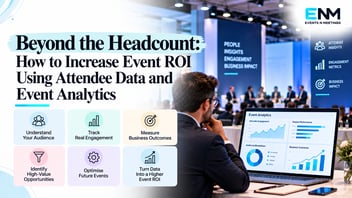
Data and Analytics Are Changing How Events Are Measured
Attendance numbers have traditionally been one of the most visible event metrics.
But registration alone does not tell organisers what attendees actually experienced.
Event analytics can provide a much broader picture.
Depending on the technology stack, organisers can track:
- Registration sources.
- Attendance and check-in.
- Session participation.
- App engagement.
- Poll responses.
- Networking activity.
- Exhibitor interactions.
- Content downloads.
- Survey responses.
- Lead activity.
- Post-event engagement.
This creates opportunities for data-driven event management.
Instead of asking only, "How many people attended?", organisers can ask:
- Which sessions generated the strongest engagement?
- Which content attracted the most interest?
- Where did attendees drop off?
- Which channels generated registrations?
- Which exhibitors received the most interaction?
- What should be changed at the next event?
Cvent's 2026 research highlights the increasing importance of events as sources of first-party data and measurable insight, particularly as digital attribution becomes more difficult.
Key questions:
- What data do we actually need?
- Where is that data stored?
- Can different systems communicate with each other?
- How will the data influence future decisions?
- Are we collecting information simply because the technology allows it?
Good analytics should lead to better decisions, not simply larger dashboards.
Hybrid and Virtual Events Are Becoming More Sophisticated
The conversation around hybrid events has moved beyond simply streaming an in-person event online.
Modern hybrid experiences increasingly require separate consideration for people attending physically and remotely.
An online attendee may need:
- A dedicated digital agenda.
- Interactive Q&A.
- Virtual networking.
- Digital resources.
- Real-time communication.
- Access to recordings.
- Opportunities to participate rather than simply watch.
Meanwhile, physical attendees may need location-based information, networking tools and in-person engagement.
Technology can help connect both experiences.
Modern platforms can support live streaming, audience interaction, digital networking, session engagement and analytics from a central environment.
However, organisers should not assume that every event needs to be hybrid.
The right format depends on:
- Audience expectations.
- Event objectives.
- Budget.
- Geography.
- Content.
- Accessibility requirements.
- Desired networking experience.
The objective should be meaningful participation, not simply adding a livestream.
Immersive Technology Is Changing Event Experiences
Another major area of event innovation is immersive technology.
Augmented reality (AR), virtual reality (VR), projection mapping, large-format LED displays and interactive installations can make physical environments more engaging.
For example, brands can use AR to allow attendees to explore products digitally. VR can create simulated environments for training or demonstrations. Projection mapping can transform ordinary architectural spaces into visual storytelling environments.
Immersive technology can be particularly effective for:
- Product launches.
- Brand activations.
- Museums and exhibitions.
- Training events.
- Trade shows.
- Experiential marketing.
- Entertainment events.
But immersive does not automatically mean effective.
An expensive visual installation may attract attention without contributing to the event's objective.
Consider:
Does the technology improve understanding, participation, emotion or interaction?
If the answer is no, it may simply be decoration.
The strongest immersive event technology connects directly to the story or purpose of the event.
Contactless Check-In and Smart Event Operations
The registration desk is often one of the first physical touchpoints between an attendee and an event.
Long queues can create unnecessary friction.
That is why contactless event technology has become an important part of modern event operations.
QR codes, digital tickets, mobile credentials, RFID and NFC-based solutions can help streamline access and movement.
Depending on the event, these technologies can support:
- Faster check-in.
- Session access.
- Cashless payments.
- Attendance tracking.
- Access control.
- Lead capture.
- Personalised experiences.
RFID and NFC can also provide organisers with useful information about movement and participation when implemented appropriately and with suitable privacy safeguards.
Look for:
- Reliable connectivity.
- Backup procedures.
- Integration with registration systems.
- Clear attendee communication.
- Secure handling of attendee information.
Technology should make the entrance experience feel simpler, not create another technical barrier.
Event Technology Is Becoming More Integrated
One of the challenges facing event teams is the number of separate platforms they may need to manage.
Registration might happen on one platform. Email marketing on another. The event app may sit somewhere else, while lead collection, CRM, analytics and virtual streaming use additional systems.
This can create fragmented data and additional manual work.
That is why integrated event technology is becoming increasingly important.
Instead of operating as disconnected tools, event platforms can connect different stages of the attendee journey.
An integrated system can potentially connect:
Registration → Communication → Event App → Engagement → Analytics → CRM → Follow-Up
The benefit is not simply convenience.
Integration can provide a more complete understanding of the attendee journey while reducing repetitive data entry.
Before selecting a platform, organisers should examine:
- Available integrations.
- API capabilities.
- CRM compatibility.
- Data export options.
- Reporting functionality.
- Security requirements.
- Ease of implementation.
A platform with fewer features but stronger integration may sometimes be more useful than a platform with dozens of disconnected features.
Sustainability Is Also Becoming a Technology Question
Sustainability is often discussed in terms of venue selection, catering and transportation, but technology can contribute as well.
Sustainable event technology can support:
- Digital tickets.
- Paperless registration.
- Digital event programmes.
- Smart energy monitoring.
- Resource tracking.
- Virtual participation.
- Digital communication.
- Data-based capacity planning.
Technology can also help organisers understand where resources are being used.
For example, better attendance forecasting can help reduce unnecessary printing, catering waste or unused event capacity.
However, digital technology itself has an environmental footprint.
Therefore, sustainability should not simply mean replacing physical materials with digital ones.
Consider the entire technology lifecycle, including equipment, energy consumption, data infrastructure, transportation and disposal.
Cybersecurity and Data Privacy Cannot Be an Afterthought
As events collect more attendee information, event data security becomes increasingly important.
Registration platforms may hold names, contact information, professional details, payment information, preferences and engagement data.
AI tools may introduce additional questions around how data is processed, stored and shared.
Event organisers should therefore consider:
- What personal information is being collected?
- Why is it being collected?
- Who can access it?
- Where is it stored?
- How long is it retained?
- Which third-party platforms receive it?
- What happens if a technology provider experiences a security incident?
Privacy and consent should be considered during technology selection rather than after implementation.
This is especially important when using AI-powered communication, attendee profiling or third-party analytics.
Technology should improve the attendee experience without compromising trust.
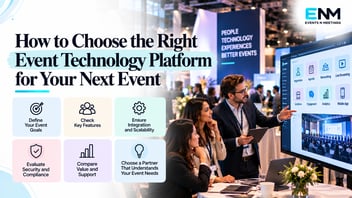
How to Choose the Right Event Technology
With so many tools available, choosing technology can become overwhelming.
A practical approach is to work backwards from the event objective.
Step 1: Define the problem
Are you trying to reduce registration queues, increase networking, improve engagement or demonstrate ROI?
Step 2: Identify the audience
What technology will actually be useful to your attendees?
Step 3: Review your existing systems
Avoid buying technology that duplicates something you already have.
Step 4: Check integration
Determine whether the platform can communicate with your CRM, registration, marketing and analytics systems.
Step 5: Calculate the total cost
Consider licensing, setup, training, equipment, support and implementation—not just the advertised subscription price.
Step 6: Test before the event
A technical problem during the event is significantly harder to solve than one discovered during testing.
Step 7: Measure the outcome
Define success before implementation.
For example:
- Reduce check-in time.
- Increase session participation.
- Improve networking activity.
- Increase qualified leads.
- Improve attendee satisfaction.
- Reduce operational workload.
This creates a clearer event technology ROI framework.
Practical Event Technology Checklist
Before introducing a new technology solution, ask:
- Does it solve a genuine event problem?
- Does it improve the attendee journey?
- Is it easy to use?
- Can it integrate with existing systems?
- Is the data secure?
- Can the team operate it confidently?
- Is there technical support available?
- Does it work reliably under event conditions?
- Can its impact be measured?
- Does the cost match the expected value?
If the technology cannot answer these questions clearly, further evaluation may be needed.
Common Mistakes When Adopting Event Technology
1. Choosing technology because it is trending
A popular tool is not necessarily the right tool for every event.
2. Adding too many platforms
More technology can sometimes create more complexity.
3. Ignoring the attendee experience
A sophisticated backend means little if attendees find the interface confusing.
4. Collecting data without a purpose
Data should support decisions rather than simply increase the amount of information stored.
5. Forgetting the human element
Technology should enable better human interaction—not replace every interaction.
6. Failing to test
Registration, connectivity, app access, screens, payment systems and integrations should be tested before attendees arrive.
7. Measuring only attendance
A successful event should be assessed against its actual objectives, whether that means engagement, networking, leads, learning, revenue or brand outcomes.
The Future of Event Technology and Innovation
The next stage of Event Technology and Innovation is unlikely to be about one revolutionary piece of technology.
Instead, the industry is moving towards connected systems that combine AI, automation, data, personalisation, immersive experiences and human interaction.
The direction is already visible in 2026: event professionals are increasingly focused on practical AI use, integrated data and experiences that provide measurable value.
The most effective events will not necessarily be the ones with the largest number of digital features.
They will be the ones where technology quietly removes friction, makes information more relevant, helps organisers make better decisions and gives attendees more meaningful ways to participate.
Ultimately, event technology should make events feel more human, not less human.
Final Thoughts
The modern event is becoming a connected ecosystem rather than a single day on a calendar.
From the first registration click to post-event follow-up, technology can influence how people discover, attend, participate in and remember an event.
The key is not to adopt technology simply because it is new. Event Technology and Innovation should be driven by purpose: reducing friction, improving engagement, supporting better decisions and creating measurable value.
As AI, analytics, immersive experiences and integrated event platforms continue to develop, event organisers have more tools than ever before. The challenge—and opportunity—is choosing the ones that genuinely make the experience better.
FAQs About Event Technology and Innovation
1. What is event technology?
Event technology refers to digital tools and systems used to plan, manage, deliver and measure events. This can include registration platforms, event apps, AI tools, virtual event platforms, check-in systems, networking technology, analytics and audience engagement tools.
2. What are the biggest event technology trends in 2026?
Major event technology trends in 2026 include practical AI adoption, personalised attendee experiences, event analytics, integrated platforms, smarter event apps, immersive experiences, contactless technology and more sophisticated hybrid event solutions.
3. How is AI changing event management?
AI in event management can assist with planning, automation, attendee recommendations, matchmaking, customer support, content analysis and post-event reporting. The focus is increasingly shifting towards practical applications that provide measurable value.
4. What is an event management technology platform?
An event management technology platform is software designed to support multiple aspects of event planning and delivery. Depending on the platform, this can include registration, ticketing, attendee communication, event apps, networking, check-in and analytics.
5. How does technology improve attendee engagement?
Technology can improve attendee engagement by providing personalised content, live polling, Q&A, networking recommendations, gamification, mobile notifications and interactive experiences.
6. Are hybrid events still relevant?
Yes. Hybrid event technology continues to support organisations that want to connect in-person and remote audiences. However, hybrid should be selected based on the event's objectives and audience rather than treated as an automatic requirement.
7. What is event analytics?
Event analytics involves collecting and analysing information about registration, attendance, engagement, sessions, networking, content and other event activities. The objective is to understand performance and improve future decisions.
8. What should organisers consider before adopting new event technology?
Organisers should consider the problem being solved, attendee needs, integration capabilities, cost, usability, security, technical support and measurable outcomes. The technology should have a clear connection to the event's objectives.
9. Can event technology help increase event ROI?
Yes. Event technology and analytics can help organisers improve operational efficiency, increase engagement, generate better attendee insights and demonstrate outcomes. However, technology itself does not guarantee ROI; the result depends on how effectively it is selected and implemented.
10. What is the future of event technology?
The future of event technology and innovation is likely to involve increasingly connected platforms, AI-assisted workflows, personalised experiences, real-time analytics, immersive technology and smarter automation. At the same time, human interaction and trust will remain central to successful events. Cvent's 2026 research similarly points to the continued importance of live experiences and measurable first-party event data.